<!DOCTYPE html>
Protecting Your Home Foundation With Professional Parging Repair | Depend Exteriors
Protecting Your Home Foundation With Professional Parging Repair
Serving Delton, Edmonton, AB — T5G 0B1, T5G 0C1, T5G 0H1, T5G 0L1
Depend Exteriors — Licensed Edmonton stucco contractor | WCB Alberta insured | BBB accredited | 20+ years experience
Why parging matters in Delton and North Central Edmonton
Delton sits in North Central Edmonton. The streets show a mix of post-war bungalows and modern infill builds. Many foundations date to the 1950s and 1960s. The area sees wide temperature swings. Winter drops near -30°C. Spring thaw loads the ground with moisture. Freeze-thaw cycles stress exterior wall systems and foundation coatings.
Parging protects foundation walls above grade. It blocks capillary moisture and salt. It shields concrete and block from impact and UV. In Delton, parging failure invites spalling, efflorescence, and water penetration. Those issues spread into stucco claddings. They can move into the building envelope. An early parging repair reduces structural risk. It preserves curb appeal. It also supports energy performance by keeping the base of the wall dry.
Built for Delton homes and Edmonton soil conditions
Local context guides every decision. Many Delton lots hold clay-heavy soils. Spring heave can create hairline movement at the base of walls. That movement cracks parging and the lower stucco coats. Properties near Delton School, the Delton Community League, and Borden Park see similar patterns. Wind exposure near Northlands Park and the NAIT campus adds abrasion and freeze-blast on corners. Homes along routes to Kingsway Mall see more sand and de-icer spray, which accelerates surface wear.
Depend Exteriors understands these patterns. The team works across Delton, Eastwood, Westwood, Alberta Avenue, Elmwood Park, Killarney, and Lauderdale. The crews see how drainage, snow storage, and sump discharge mark the parging line. That experience shapes repair plans that last. It also drives material selection for each exposure zone.
How a parging failure starts and spreads
Parging is a thin protective render. It bonds to cast-in-place concrete or to concrete block. In Delton, it often sits a few inches above grade. Ice pressure, wet-dry cycling, and salts break its bond over time. Hairline fissures admit moisture. Scaling follows on the face. If the crack aligns with a cold joint or honeycombed concrete, water enters the wall body. The moisture then wicks up into the stucco base coat. Efflorescence forms as white salts. With more winters, spalling grows. The finish coat can blister or bulge near grade.
The building envelope then faces risk. Water tracks behind flashing or at the weep screed. It moves into the lath plane. In older hard coat stucco, the brown coat may show delamination. In newer EIFS, wet EPS insulation board and base coat lose pull-off strength. Thermal bridging increases around the base. Cold floors and musty smells follow indoors. A small parging crack can become a wall system problem.
Telltale signs Delton homeowners should watch
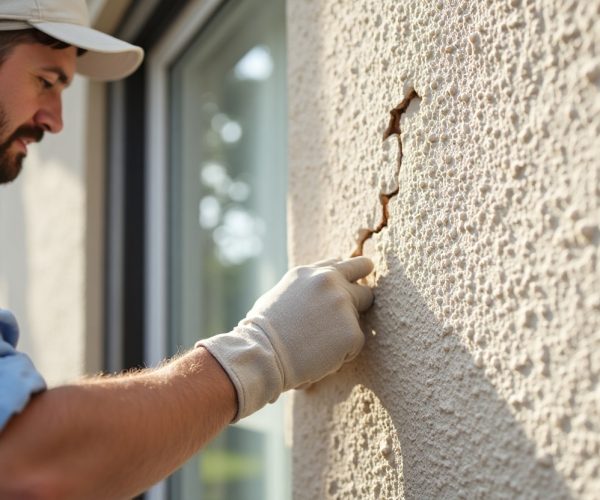
Depend Exteriors documents common patterns in the T5G postal code. Spiderweb cracks near hose bibs or along planter edges show frequent wetting. Chipping near downspouts points to splash-back. Rust staining at the lath line signals trapped water. A bulging stucco panel near grade can mean failed drainage or delamination. Frost crystals in hairline cracks on cold mornings confirm water ingress. These signals connect the parging zone with the health of the full exterior wall system.
How professionals diagnose parging and wall system issues
The process starts with a visual survey. The crew marks cracks, hollow-sounding areas, and scaling zones. They note the location of the weep screed, the condition of flashing, and the sealant lines at grade transitions. Then they check the surface with a moisture meter. Readings show if the face or substrate is damp. Infrared thermal imaging spots colder, wet sections behind the finish. It helps find water tracks from failed expansion joints or from deteriorated paper barrier in older stucco.
Where EIFS is present, technicians check the base coat, fiberglass mesh, and finish coat integrity. They look for impact damage near walkways and entries. On traditional cementitious stucco, they tap for delamination between scratch coat, brown coat, and finish coat. Around the foundation, they test compressive resistance on the parging face. If scaling dislodges with light pressure, deeper replacement is set. If bond remains, a re-skim with acrylic-modified base may work.
The right tools and site setup make the difference
Depend Exteriors sets scaffolding systems where access is tight or grade is uneven. The team uses power mixers to batch consistent repair mortars and acrylic base coats. Pneumatic staplers fix new lath where stucco remediation extends past the foundation line. Mechanical fasteners secure EPS insulation boards on EIFS repairs. Moisture meters and infrared thermal imaging verify dry-down before coating. This disciplined approach reduces callbacks and keeps the schedule tight in short Edmonton summers.
Material science behind durable parging in Edmonton
Parging needs strong adhesion, low permeability, and freeze-thaw resilience. Acrylic-modified cements provide flex and bond to dense concrete. For heritage homes, a lime-cement blend can reduce cracking and match historic texture. Where the wall needs more protection at snow load zones, a polymer finish coat improves abrasion resistance. Pigments from AkzoNobel support color stability in high-UV conditions, which is valuable for exposed south faces.
For full wall stucco and EIFS systems, the brand choice matters. Depend Exteriors installs systems and finishes from Imasco Minerals, Sto Corp, Dryvit Systems, DuRock Alfacacing International, Senergy, and Master Wall. On premium projects, the team specifies Parex or Adex Systems for higher R-values and strong color hold. BASF Wall Systems technology informs many resin chemistries in these products. With the right mesh weights and base coats, these systems stand up to freeze-thaw cycles and wind-driven rain common in Delton.
How parging connects to stucco and EIFS performance
The lower wall acts as a stress zone. It takes splashing, shovels, and snowpack. It faces ice jacking. That stress can push movement into the stucco above. A solid parging line keeps surface water from running behind the finish at the weep screed. It protects the drainage plane. It reduces risk at the lath staples and the mechanical fasteners. If there is EIFS, it guards the EPS insulation board from wetting and freeze fracture at base trim. That is why a parging repair project often pairs with sealant replacement and joint maintenance on the wall system.
Crews check expansion joints. They replace the backer rod and sealant where needed. They check flashing for proper laps and kick-outs. They confirm the weep screed is clear. On hard coat stucco, they verify the scratch coat and brown coat remain sound. On EIFS, they re-embed fiberglass mesh where base coat damage appears. These small steps keep the building envelope intact.
Step-by-step: a professional parging repair in Delton
The crew begins with surface prep. Loose parging is removed back to a solid edge. The concrete is cleaned to sound substrate. If efflorescence is heavy, the team neutralizes salts. Where the wall shows spalling or voids, a patch mortar fills and rebuilds the plane. Movement cracks are routed and bridged with a flexible acrylic base. At grade transitions, crews set a clear line above soil or mulch to avoid wicking. Downspout discharge is shifted or extended to stop splash-back.
Once the base reads dry on moisture meters, bonding agents are applied. A two-coat acrylic-modified parging is placed by trowel. In high-impact corners, fiberglass mesh is embedded in the first pass. The finish is floated to match adjacent textures. Where color is in scope, a breathable acrylic finish is applied. Sealant lines are set with proper backer rod to create a true expansion joint. Finally, drainage checks confirm water moves away from the wall.
Quick homeowner check before snow season
- Look for hairline cracks or scaling near grade along the driveway side.
- Check for white powdery salts on parging or stucco faces after rain.
- Probe soft spots with a key. If it crumbles, plan a repair.
- Watch for bulges or hollow sounds at the base of stucco panels.
- Confirm downspouts discharge at least two metres from the foundation.
Choosing the right parging mix for Edmonton weather
There is no single mix for every property. The exposure and substrate govern the choice. Along lanes with heavy plow spray, a denser acrylic-modified cement resists salts and impact. On shaded north walls where freeze-thaw hits harder, a slightly more flexible base reduces micro-cracks. Heritage homes with lime-based mortars benefit from a lime-cement parging that handles thermal movement. If the parging meets EIFS trims, compatibility with the base coat resin avoids bond conflicts.
Trusted manufacturers and color systems
Depend Exteriors uses products with proven performance in Alberta. Imasco Minerals and Sto provide stable acrylic finishes and high-quality base coats. Dryvit Systems and Senergy offer EIFS packages with tested drainage planes and mesh options. DuRock Alfacacing International and Master Wall supply base and finish materials with strong adhesion to varied substrates. For premium EIFS projects seeking better R-values and finish clarity, Parex and Adex Systems lead the field. AkzoNobel pigments support consistent color in harsh UV. Technologies from BASF Wall Systems inform resins that handle both cold snaps and warm chinooks.
Engineering details that extend service life
Good parging relies on more than the mix. It relies on detailing. Soil should sit below the parging line to break capillary rise. Where planter beds meet the wall, a drain gap saves the surface from constant wetting. Base termination of EIFS must include a drip to shed water. The weep screed should remain clear. Flashing around steps and decks needs a proper kick. Joints require clean backer rod sized to two-thirds the joint width for correct sealant geometry. These small parts prevent water from reaching lath, paper barrier, and the drainage plane.
Where stucco cracks form, routing and filling with a compatible, textured repair stops water penetration. For structural cracks, backer rod and high-quality sealant create a working joint. Efflorescence calls for source control. That means fixing grading and splash zones, not just cleaning the surface. If delamination spreads, cut-and-patch to sound scratch and brown coats keeps failures from creeping. Infrared thermal imaging can guide selective demolition to the wet sections, which saves cost and preserves original finishes.
Parging versus full stucco remediation at the base
Some homes need parging alone. Others need broader stucco remediation at the base. The choice rests on moisture readings, bond tests, and crack mapping. If only the parging has failed but the stucco above is sound, a focused parging repair is practical. If water has moved behind the weep screed or base trim, the safer route pulls back finish to expose the drainage plane. Then crews rebuild with fresh base coat, fiberglass mesh, and a compatible finish coat. This approach also allows for expansion joint resets and flashing upgrades that reduce risk long term.
How Depend Exteriors executes at Delton job sites
Site protection matters. Crews lay protection mats along walks. Downspouts are hooked to temporary hoses to avoid fresh work. Vegetation gets breathable covers. Power mixers sit on containment trays to keep the site clean. Scaffolding systems are tied off as required. Where narrow side yards exist, modular platforms create safe footing without disturbing fences.
Communication stays clear. Homeowners see daily progress updates. Weather windows are planned in advance. Cold-weather additives and heated tents allow late fall work when required. Moisture meters confirm cure before finish coats. Final photos document each step for the record and warranty support.
Complete exterior wall systems thinking
As a stucco contractor and plastering contractor serving Delton, the team treats each facade as an integrated system. Components include lath or wire mesh, scratch coat, brown coat, and finish coat on hard coat assemblies. EIFS assemblies include EPS insulation board, fiberglass mesh, base coat, and a textured acrylic finish. Key elements such as drainage plane, backer rod, sealant, expansion joints, and weep screed control water and movement. Problems such as stucco cracks, bulging stucco, efflorescence, water penetration, spalling, and delamination all tie back to these parts. Issues like mold growth, thermal bridging, flashing failure, and a deteriorated paper barrier show up when water bypasses the intended paths. Diagnosing those paths and rebuilding them is the core service.
Field examples from North Edmonton
On a 1958 Delton bungalow near T5G 0C1, the lower south wall showed scaling parging and a bulge at the first floor. Moisture meters read high behind the finish. Thermal imaging revealed a cold stripe tracking a failed expansion joint. Crews removed 600 mm of finish to the weep screed. They replaced backer rod and sealant, re-embedded fiberglass mesh in new base coat, and installed a two-coat acrylic-modified parging. The wall dried, and energy bills dropped an estimated 5 to 8 percent due to reduced air leakage and thermal bridging.
On a 2012 infill near Westwood and NAIT, the EIFS base trim sat too low at a snow storage zone. Impact from ice removed finish in spots. EPS insulation board had minor damage. The team cut back to sound board, installed new EPS with mechanical fasteners, and applied a reinforced base coat. A drainage check confirmed a clear path. A high-wear acrylic finish completed the repair. A graded gravel strip now protects the base from future shoveling damage.
What makes a strong “stucco contractor Delton AB” partner
Local knowledge reduces guesswork. A dependable Delton stucco contractor anticipates how winter chinooks, wind, and snow piles interact with each facade. The contractor also understands the architectural style of Delton’s post-war homes and newer infills. That shapes texture matches, color picks, and joint layouts. Working with a licensed Edmonton contractor who holds WCB Alberta coverage and BBB accreditation adds safety and accountability. Add specialized EIFS certification and heritage home restoration experience, and repairs fit both code and character.
Services aligned to Delton’s building stock
Depend Exteriors provides parging repair, stucco remediation, EIFS repairs, and full exterior wall systems upgrades across Delton and adjacent neighborhoods. The team manages acrylic stucco installations and traditional hard coat stucco work. They correct flashing failure and reset expansion joints. They replace deteriorated paper barriers during selective demolition where needed. They resolve water penetration and efflorescence. If spiderweb cracks spread across large areas, crews stabilize and refinish the wall. If bulging stucco signals deep issues, they open, dry, and rebuild to the drainage plane. Every action targets a healthy building envelope.
Quality control and warranty support
Moisture readings are logged before and after repairs. Base coat adhesion is spot-checked with pull tests on selected projects. Mix ratios remain consistent via measured batching with power mixers. Sealant joints are inspected for correct profile. Finish coat curing is timed to weather conditions. Photos of lath, mesh, and terminations stay on file. The company provides a written warranty that covers labor and materials. It aligns with manufacturer guidance for systems by Sto, Dryvit, Imasco, and others.
Coverage across North Central Edmonton and beyond
The crew serves the T5G area and nearby postal codes. Work is frequent near Delton Community League, Delton School, Northlands Park, NAIT, Kingsway Mall, and Borden Park. Service also extends to St. Albert, Sherwood Park, Leduc, Spruce Grove, Stony Plain, and Devon. That footprint supports fast response for both small parging repairs and larger wall system projects. Site familiarity keeps mobilization efficient and respectful of neighbors.
Repair timing and cost ranges
Small parging repairs near steps or hose bibs often fit a one-day scope in mild weather. Moderate runs along a side yard average two to three days due to prep and cure times. Larger base-of-wall remediation with stucco cutbacks may take a week or more. Costs vary with access, demolition, reinforcement, and finish needs. Many homeowners choose to pair parging with sealant replacement and downspout redirection. That bundling solves the source and the symptom, which reduces lifetime spend.
How to evaluate the right contractor for parging repair
Ask about moisture meter use and infrared thermal imaging. These tools reveal hidden water issues. Confirm experience with both acrylic-modified parging and traditional cement-based mixes. Verify competency in EIFS interfaces and hard coat stucco terminations. Request brand familiarity with Imasco, Sto, Dryvit, DuRock, Senergy, Master Wall, Parex, Adex, and BASF-related chemistries. Check insurance, WCB status, and licensing. Look for a clear written warranty and photo documentation of hidden steps such as mesh embedment and backer rod installation.
Two common parging strategies used in Delton
- Acrylic-modified cement parging for high-traffic, salt-prone faces near lanes and driveways.
- Lime-cement parging for heritage foundations to harmonize with older mortar and reduce crack stress.
Safety and site respect
Crews work within municipal guidelines and manufacturer installation manuals. They set up safe access using scaffolding systems where needed. They maintain clean paths for homeowners and tenants. Dust control matters in dense neighborhoods. Waste is contained and hauled the same day when possible. The aim is reliable results, minimal disruption, and a site ready for life to continue.
Trade classification and documentation
In local procurement listings, stucco contractor services can appear under various divisions, including Division 11 references in some systems. More broadly, the company documents exterior wall systems, parging repair, and EIFS specialist work so homeowners have clear records for resale and insurance. That documentation includes brand data sheets, color codes, and cure logs where relevant.
Frequently asked questions about parging and stucco in Delton
How long does new parging last in Edmonton conditions? With proper prep and a quality acrylic-modified mix, 15 to 25 years is common. Exposure and drainage control affect service life.
Can parging fix a leaking basement? Parging is not a waterproofing system. It is a protective render above grade. It helps keep splash and salts off the wall. If basement leaks exist, the repair plan may include grading, downspout changes, and other measures. Parging still plays a useful role in a total solution.
Will a skim coat over failing parging hold? A skim over loose or salt-laden material will fail. Sound substrate is critical. Salt neutralization and solid edges are required. Where bond is weak, remove and rebuild.
Can EIFS be repaired near grade without full replacement? Yes, if the damage is localized and drainage paths remain intact. Replace damaged EPS, re-embed fiberglass mesh, and reset trims. Verify moisture levels before finishing.
Do you work through winter? Yes, within safe temperature windows. Heated tents and admixtures allow select repairs. Scheduling works best in spring to fall for scale and finish quality.
Why Depend Exteriors is a strong fit for Delton homes
The team specializes in parging repair that stabilizes the whole exterior system. They fix stucco cracks, efflorescence, spalling, and delamination with methods built for the Edmonton climate. They use calibrated moisture meters and thermal imaging to map water ingress before it harms structure. Their Delton crews install galvanized wire lath and 1-inch EPS insulation boards where EIFS upgrades apply, which strengthens the building envelope and reduces thermal bridging. They source materials from Sto, Dryvit, and Imasco for color consistency and durability. For higher energy targets, they recommend Adex or Parex EIFS packages with strong R-values.
Depend Exteriors stands as a licensed Edmonton contractor. The company is WCB Alberta insured and BBB accredited. Work includes a written warranty. Estimates are detailed and free. The firm brings 20+ years of local experience with both modern EIFS and traditional hard coat stucco. Heritage home restoration expertise helps match textures common across Delton, Alberta Avenue, and nearby streets.
Local signals that matter for search and service
Depend Exteriors works daily in the T5G area, near Delton School and Northlands Park. The team fields calls from Eastwood, Westwood, Killarney, Lauderdale, and Elmwood Park. Crews navigate tight lots and shared lanes common to mature neighborhoods. The office responds quickly for properties around Kingsway Mall and NAIT. This footprint supports rapid site visits and accurate, location-aware diagnosis for Delton clients.
Ready for a precise parging repair that protects your foundation?
Book a no-obligation inspection for your Delton property. A specialist will assess parging, stucco, and EIFS interfaces. You will receive a clear plan with photos and itemized pricing. Work is performed by a WCB-insured, BBB-accredited, licensed Edmonton stucco contractor. Materials come from trusted brands like Imasco, Sto, and Dryvit. Premium options from Adex and Parex are available for higher performance targets.
Call +1 780-266-4112 or request a site visit online. Appointments are available across T5G 0B1, T5G 0C1, T5G 0H1, and T5G 0L1. Depend Exteriors is the practical choice for a stucco contractor Delton AB homeowners can trust for durable parging repair and complete exterior wall systems care.
Depend Exteriors Stucco Repair Experts in Edmonton, AB
Depend Exteriors provides hail damage stucco repair across Edmonton, AB, Canada. We fix cracks, chips, and water damage caused by storms, restoring stucco and EIFS for homes and businesses. Our licensed team handles residential and commercial exterior repairs, including stucco replacement, masonry repair, and siding restoration. Known throughout Alberta for reliability and consistent quality, we complete every project on schedule with lasting results. Whether you’re in West Edmonton, Mill Woods, or Sherwood Park, Depend Exteriors delivers trusted local service for all exterior repair needs.
Depend Exteriors
8615 176 St NW
Edmonton,
AB
T5T 0M7
Canada
Phone: (780) 710-3972
Website: dependexteriors.com | Google Site | WordPress